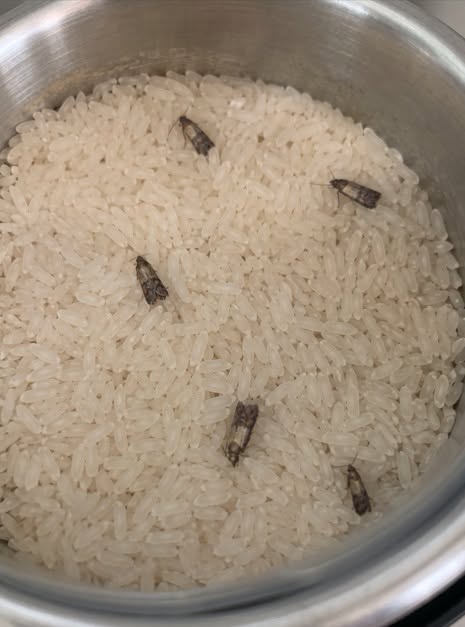
Just take a quick look at packages before storing them.
Keep the Pantry Dry and Organized
A clean, organized pantry makes problems much easier to spot.
When everything is crammed together, a single infested package can hide for weeks.
When you can actually see your food, you’ll notice something unusual much faster.
Should You Use Mothballs in the Pantry?
No.
Mothballs are designed for specific pest-control uses and are not a food-safe pantry treatment.
Don’t place mothballs anywhere near food.
If you’re dealing with pantry moths, focus instead on removing infested food, cleaning thoroughly, storing food securely, and monitoring with an appropriate pantry moth trap.
What About Essential Oils?
You’ll find plenty of advice online recommending peppermint, bay leaves, lavender, or other strongly scented products as pantry moth repellents.
They may smell lovely, but I wouldn’t rely on them as your primary solution.
A strong-smelling herb isn’t going to remove an infestation that’s already established inside a bag of flour.
Find the food source first.
That’s the part that matters most.
What to Do If You Keep Finding Pantry Moths
If you’ve cleaned the pantry and moths keep appearing, don’t panic.
Go back to detective mode.
Look Beyond the Obvious
Check food stored elsewhere in the kitchen.
Then check pet food.
Then birdseed.
Then forgotten baking supplies.
Don’t forget the little-used ingredients hiding in the back of cabinets.
Look Up, Too
If adult moths are appearing away from the pantry, inspect upper cabinet corners, ceilings, wall edges, and other sheltered areas.
The larvae may have traveled away from the original food source before pupating.
Don’t Stop After One Cleaning
A second inspection can reveal something you missed the first time.
Sometimes the answer really is one forgotten package.
Pantry Moth Prevention Checklist
Here’s the simple version you can save:
☐ Empty the affected pantry
☐ Inspect every dry food package
☐ Discard clearly infested food
☐ Vacuum cracks and corners
☐ Wash shelves thoroughly
☐ Check nearby cupboards
☐ Inspect pet food and birdseed
☐ Use pheromone traps for monitoring
☐ Transfer susceptible foods to airtight containers
☐ Rotate older food
☐ Clean spills promptly
☐ Continue monitoring for several weeks
Honestly, this checklist is worth keeping.
Because nobody wants to discover pantry moths twice.
Frequently Asked Questions
How do pantry moths get into my house?
They can sometimes enter through contaminated food products brought home from a store, warehouse, or other source. They can also spread from one stored food item to another after an infestation becomes established.
Can pantry moths live in an unopened package?
Yes, depending on the packaging. Some thin cardboard, paper, and flexible packaging may not provide a reliable barrier.
That’s one reason airtight storage containers are so useful.
Do pantry moths bite?
No. Pantry moths aren’t known for biting people.
The problem is food contamination and the inconvenience of the infestation.
Are pantry moths the same as clothes moths?
No.
Pantry moths are associated with stored food, while clothes moths are associated with animal-based fibers and fabrics.
If you see a moth in the kitchen, don’t automatically assume it’s a clothes moth.
How long does it take to get rid of pantry moths?
It depends on how extensive the infestation is and whether you successfully locate every source.
Because eggs, larvae, and pupae may already be present, you should continue monitoring after cleaning rather than assuming the problem is gone immediately.
Should I throw away everything in my pantry?
Not necessarily.
You generally don’t need to discard every item simply because one package was infested.
Inspect everything carefully. Discard food showing signs of infestation, and consider transferring suitable foods into clean, airtight containers.
Can I eat food that has pantry moth larvae in it?
I wouldn’t.
If you find clear evidence of infestation—such as larvae, webbing, or other contamination—the simplest option is to discard the affected food.
Do pantry moth traps get rid of the infestation?
Not by themselves.
Pheromone traps can help monitor adult male moth activity, but they don’t replace finding and removing the infested food source.
Why am I still seeing moths after cleaning?
There may be another infested food source, or moths may still be emerging from earlier stages of the life cycle.
Keep monitoring and inspect the pantry again if activity continues.
Storage and Prevention at a Glance
For everyday pantry maintenance, think:
Inspect → clean → seal → rotate → monitor.
That’s it.
You don’t need a complicated system.
You just need to make it difficult for pantry moths to find accessible food and easy for you to spot a problem early.
The Bottom Line
Pantry moths are annoying, but they’re not unbeatable.
The biggest mistake is treating only the adult moths you see flying around.
Instead, find the food source, discard contaminated products, vacuum and clean the pantry thoroughly, inspect nearby storage areas, and keep susceptible foods in airtight containers.
And please don’t skip the monitoring stage!
A few extra minutes of checking your pantry can save you from discovering another infestation months later.
Once you’ve broken the cycle, keeping pantry moths away becomes much easier.
And there is something deeply satisfying about opening a clean, organized pantry and seeing zero tiny moths fly out.
That’s the pantry peace we’re after!
More Helpful Home Tips You May Enjoy
If you’re tackling pantry moths, you might also enjoy these practical household guides:
How to Organize a Small Pantry Without Buying a Ton of Stuff
How to Get Rid of Fruit Flies Naturally
How to Clean Kitchen Cabinets Without Damaging Them
How to Keep Flour Fresh for Longer
How to Organize Your Baking Supplies
How to Clean a Really Dirty Kitchen Fast
Did This Pantry Moth Guide Help?
If you tried this method, I’d love to hear what worked for you!
Leave a review or share your pantry-cleaning results in the comments.
And if this guide helped you finally get control of those annoying little moths, save it to Pinterest so you can find it again the next time your pantry needs a reset.
You never know when that tiny moth is going to make another appearance!
General Information
This article is intended for general household information. Pantry moth infestations can vary depending on the species, food source, and extent of the infestation. If an infestation is severe, persistent, or difficult to identify, consider contacting a qualified pest-control professional.
For food safety, when in doubt about whether a contaminated food should be consumed, discard it.
Nutritional Information
There is no nutritional information for this household pest-control guide.
If you’re looking for nutrition information for a specific recipe from this site, use the nutrition panel provided with that individual recipe.