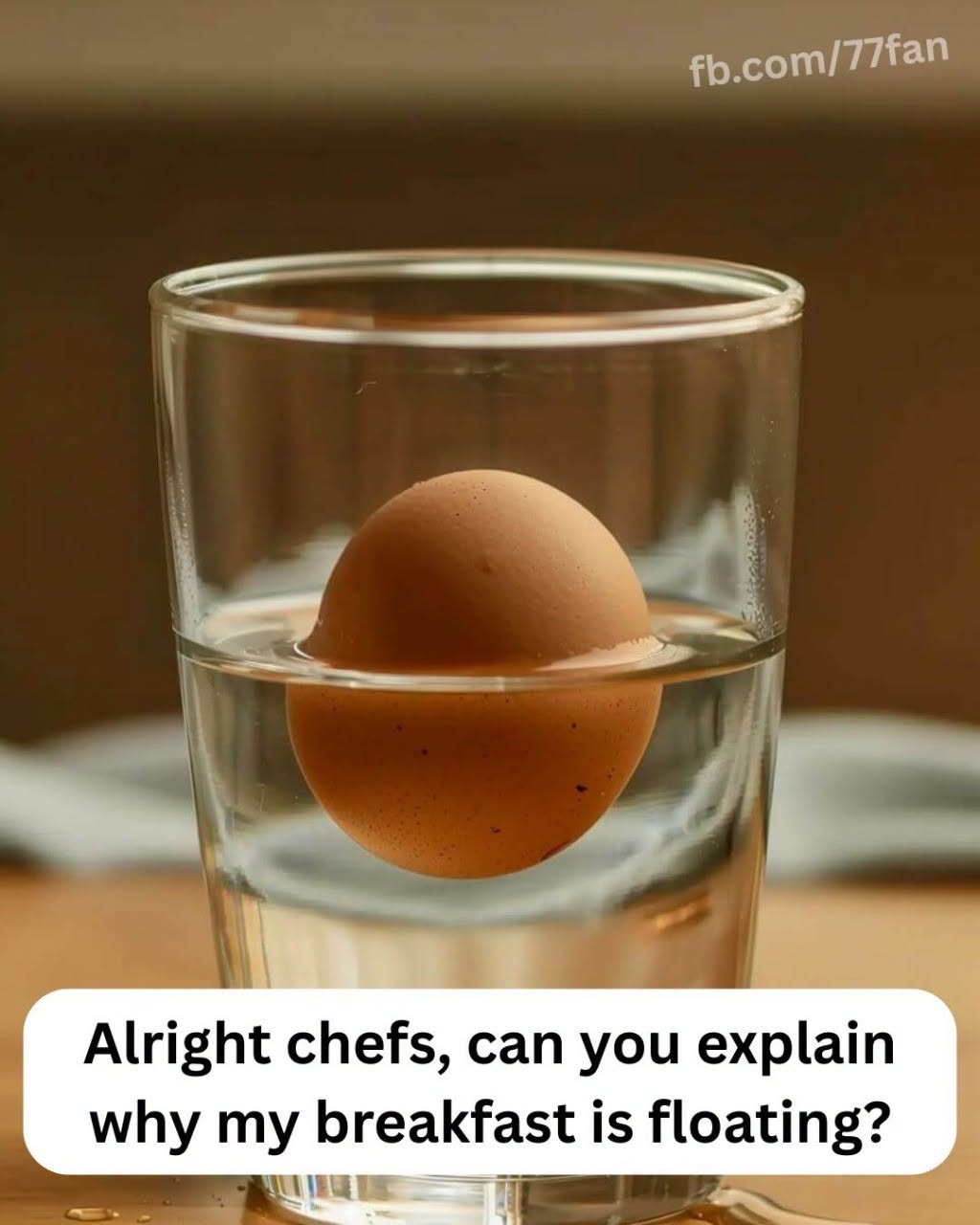
Have you ever cracked open your egg carton in the morning, filled a bowl with water to do that viral “egg test,” and watched one slowly lift off the bottom like a tiny submarine?
It can be weirdly alarming.
One second you’re making breakfast, the next you’re wondering if your eggs have turned against you.
Honestly, the egg float test has been passed around kitchens for generations—long before social media got hold of it—and there’s a reason it stuck around. It works. Mostly. But like a lot of old kitchen wisdom, there’s more nuance than the internet usually tells you.
And that matters, because eggs are too useful (and too expensive these days, let’s be honest) to toss out based on half the story.
So if you’ve ever wondered what a floating egg actually means, whether it’s automatically bad, and why some older eggs are secretly better for certain recipes… let me explain.
First Things First — Why Do Eggs Float At All?
It comes down to something surprisingly simple: air.
Every egg has a tiny air pocket inside. Freshly laid eggs have a very small one. But over time, moisture and gases slowly escape through the shell—yes, eggshells are porous—and air sneaks in.
That air pocket gets bigger.
And bigger.
Eventually, the egg becomes buoyant enough to lift in water.
That’s all floating usually means: the egg is older.
Not necessarily rotten.
That distinction gets lost a lot.
Here’s how the classic float test usually reads:
Sinks and lies flat: Very fresh
Sinks but stands upright: Older, but usually fine
Floats to the top: Very old; use caution
Simple enough, right?
Well… mostly.
Because eggs are a little trickier than that.
The Viral Float Test Isn’t Wrong—It’s Just Incomplete
You’ve probably seen the dramatic videos.
“Floating egg? Throw it out immediately!”
That makes a catchy post. But kitchen life isn’t always that black-and-white.
A floating egg doesn’t automatically equal spoiled.
It signals age.
Spoilage is a separate issue.
That’s important.
An older egg may float and still be perfectly usable, especially for baking or hard-boiling. Meanwhile, an egg that sinks can still be bad if it was mishandled.
See what I mean? Freshness and safety overlap, but they aren’t identical.
That’s where common sense—and your senses—come in.
So… How Do You Actually Tell If An Egg Is Bad?
The float test is Step One.
Step Two is the sniff-and-look check.
And honestly? This is the part chefs trust most.
Crack the egg into a bowl.
Take a look.
A good egg usually has:
A rounded yolk that sits up high
Whites that aren’t overly watery
A neutral smell (or almost no smell)
Warning signs?
Sulfur smell — big red flag
Pink, green, or iridescent tones — discard
Extremely runny whites plus flattened yolk — old, maybe past it
Anything just… off
You know what?
Your nose usually knows.